



We often treat contentment like a destination—a quiet room we finally get to lock ourselves into once we’ve accumulated just enough stuff, status, or stability.
But according to one of history’s most famous deep-thinkers on the subject, contentment isn’t a static room at all. It’s a muscle trained in the extremes.
In his letter to the Philippians, Paul the Apostle drops a line that most of us can quote by heart, yet we frequently miss the profound psychological prerequisite hidden inside it. He writes:
“I know what it is to be in need, and I know what it is to have plenty. I have learned the secret of being content in any and every situation, whether well fed or hungry, whether living in plenty or in want.” — Philippians 4:12
The Context of Paul’s Peace
To understand how radical this statement is, you have to look at where Paul was writing from: a Roman prison cell.
The Philippians had just sent him a financial gift to ease his suffering. Paul writes back to thank them, but he inserts a gentle caveat. He basically says, “Thank you, this helps—but I want you to know I was actually doing okay before it arrived.”
Paul wasn’t practicing toxic positivity or pretending his chains didn’t chafe. He was revealing a “secret” he had mastered. And that secret relies on a profound truth about human nature: True contentment requires a baseline of both lack and excess.
If you have only ever known one extreme, your view of reality is fundamentally warped. Here is why the middle ground can only be discovered by visiting both edges.
1. The Trap of Constant Lack
If a person only ever experiences scarcity, “more” becomes a god.
When you are constantly scraping by—whether that’s a lack of money, a lack of affection, or a lack of security—your brain enters a perpetual state of survival. You begin to believe a dangerous lie: If I could just get across that finish line, all my problems would disappear.
Constant lack breeds a hyper-focus on what is missing. It convinces you that joy is a commodity you currently can’t afford. Because you’ve never had excess, you never learn that excess has its own set of miseries. You assume satisfaction is just one paycheck, one promotion, or one relationship away.
2. The Trap of Constant Excess
On the flip side, look at those who have only ever known abundance. You’d think they’d be the most content people on earth, but they are often the most restless.
Psychologists call this the hedonic treadmill. When excess is your baseline, your tolerance for dopamine peaks. The first sports car is exhilarating; the fourth one is just Thursday.
If you have never experienced lack, you cannot experience gratitude because you have no contrast. Abundance ceases to be a blessing and simply becomes “the standard.” And when the standard gets boring, the only antidote your brain can come up with is more, bigger, faster, louder. Excess without the memory of lack breeds a profound, hollow boredom.
The Secret is the Contrast
Paul’s genius was realizing that contentment is born out of contrast.
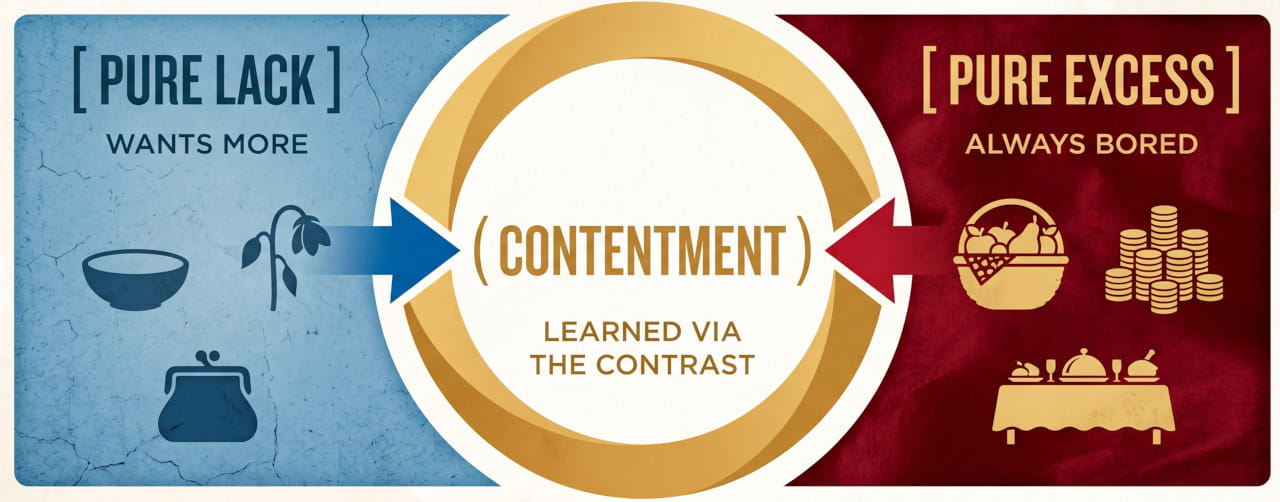
Because Paul had run the tables—he had been a high-society Pharisee with power and status, and he had been a shipwrecked, starving prisoner—he knew the truth. He knew that luxury didn’t cure anxiety, and he knew that poverty didn’t destroy soul-deep joy.
By experiencing both extremes, he broke the power that both extremes held over him. He realized that neither hunger nor a full stomach could define who he was.
Training the Muscle
If you are currently in a season of lack, look at it not just as a hardship, but as an education. It is sharpening your capacity for future gratitude. It is stripping away the illusion that your worth is tied to your net worth.
If you are in a season of excess, lean into voluntary scarcity. Fast. Give aggressively. Reconnect with what it feels like to stretch, so you don’t lose your taste for the blessings right in front of you.
Contentment isn’t something we stumble into when life perfectly aligns. It is a secret we learn when we realize that both the highs and the lows are just scenery on the road to something much deeper.