



I have always been fascinated — and a little unsettled — by how confidently people extrapolate beyond what the data actually supports. A public school education steeped in humanist assumptions didn’t help calibrate that instinct. But recently, my daughter said something that stopped me cold and forced me to examine my own.
What the Trendline Tells Us — And What It Doesn’t
The 1500-meter race has been an Olympic standard since 1896. That year, the fastest man on earth finished in just over four and a half minutes. Within sixteen years, the four-minute barrier fell — Hanns Braun crossed in 3:56.8. From there, a steady, generational compression of time played out over the next century, until 2020, when the three-and-a-half-minute barrier finally gave way.
If we were to plot this historical data onto a standard linear graph and draw a rigid secular trendline, it would suggest that mankind decreases his 1500-meter time by roughly 0.512 seconds every single year.
Olympic Men’s 1500m Gold Medal Times Over Time
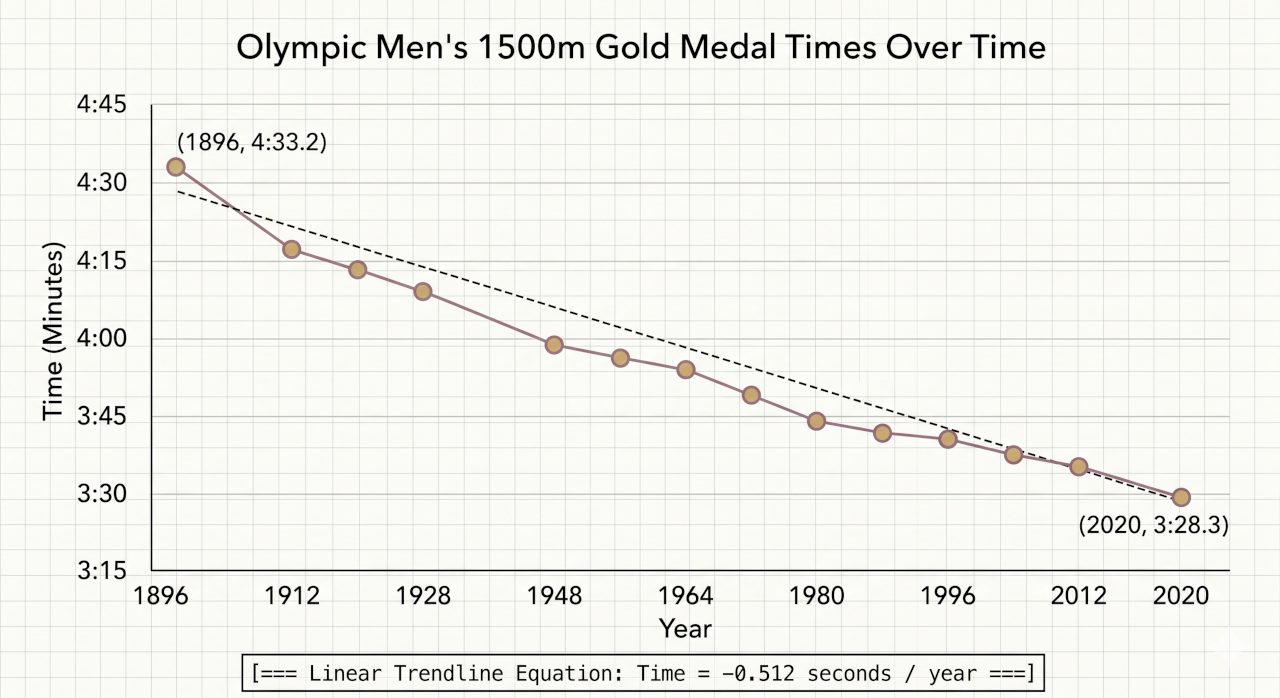
What assumptions can we make about mankind? Can we draw conclusions about his past or his future?
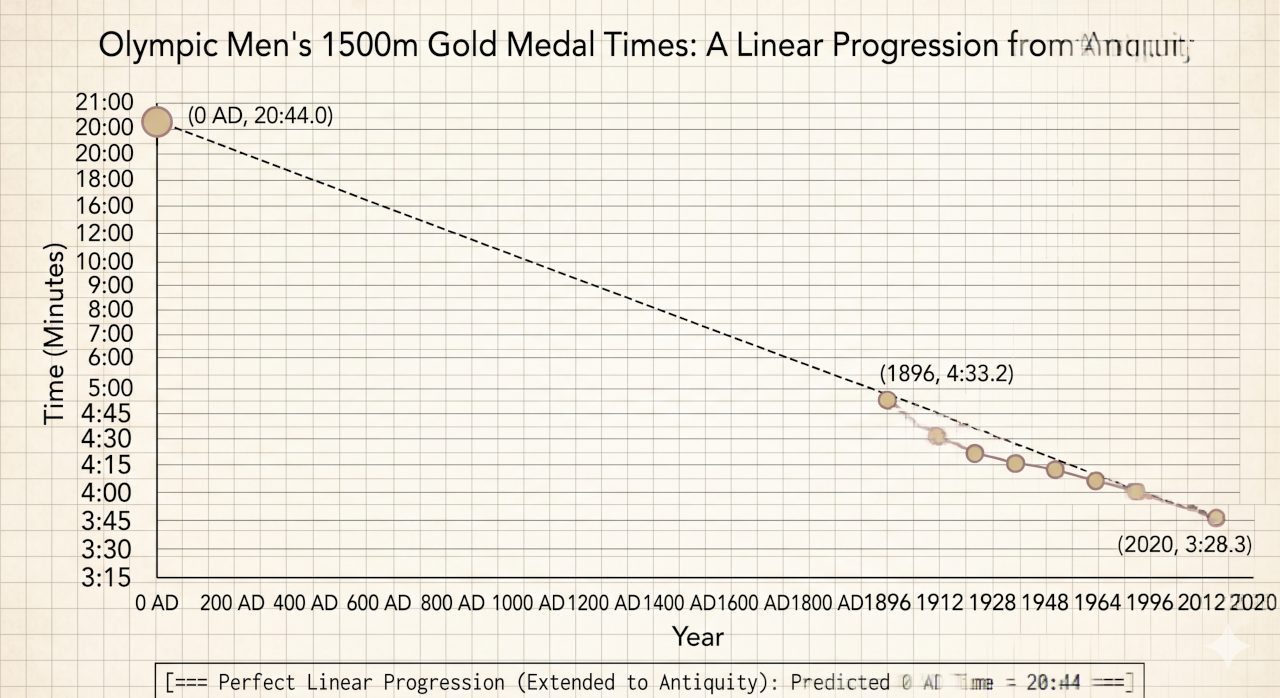
Consider this: if we were to follow the trendline backward in time, at the dawn of the Common Era (1 AD), the fastest man alive would have taken over 20 minutes to run the 1500 meters. Is that reasonable? Can that be an accurate assumption? Based upon the limited data?
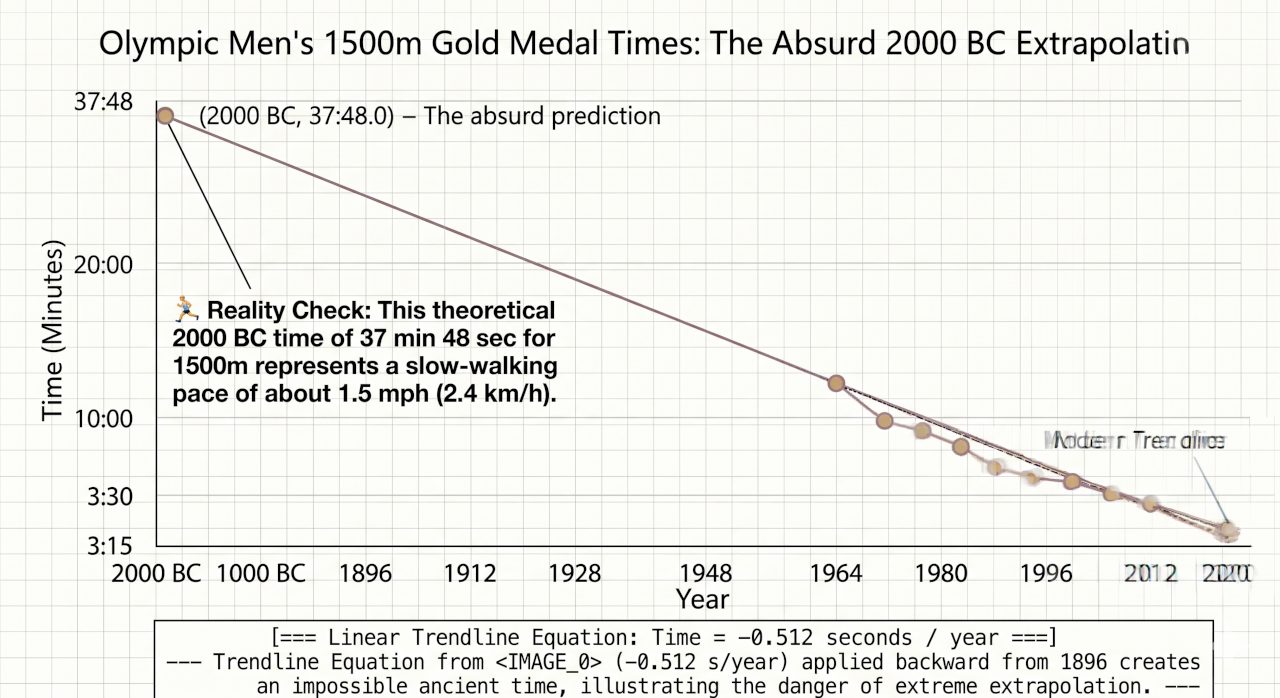
If we trace this data back to the reign of the Egyptian pharaoh Mentuhotep III, the fastest man would have taken around 38 minutes to complete the 1500 meters. This would be about the same top speed as the three-toed sloth. Is this a reasonable assumption? Was man as slow as a sloth at some point in his distant past? This would make world conquest quite a fascinating thing to watch.
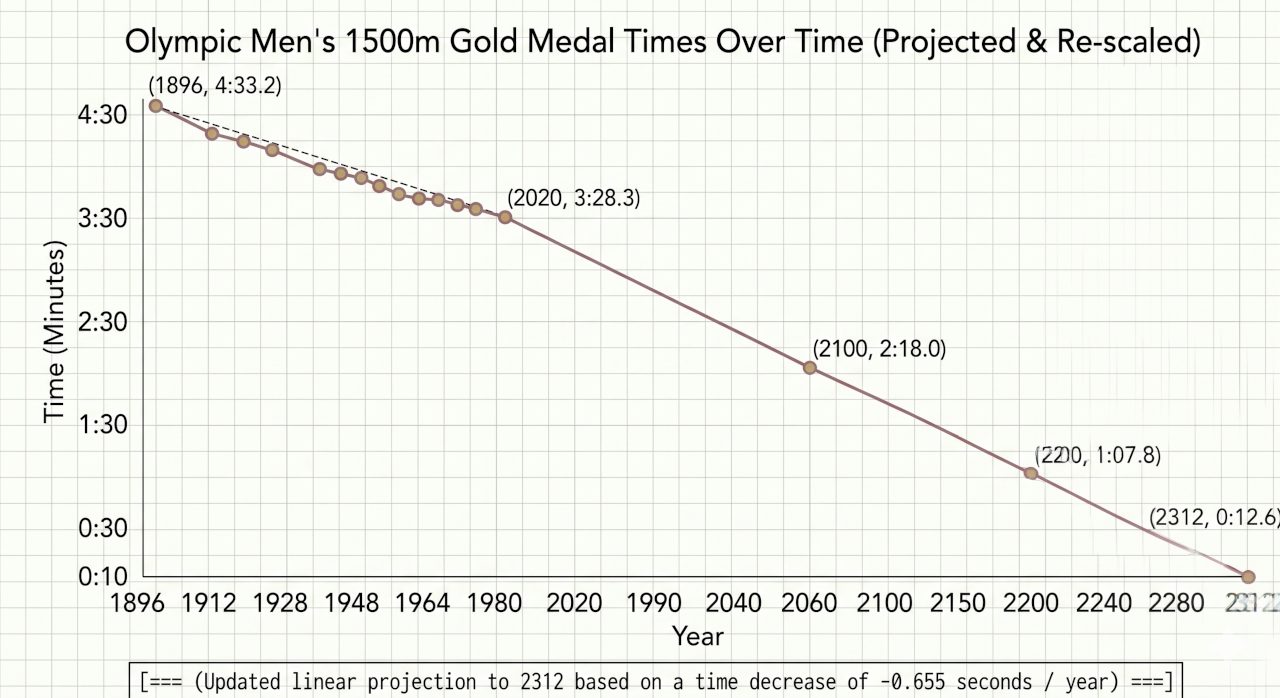
Let’s trend this into the future. According to the trendline, the fastest man alive should break the 3-minute barrier within the lifetime of my children—the next 40 years or so. Wouldn’t that be amazing? Or, if we jump ahead to year 312 AD, man will be able to blow through 1500 meters in around below 1 minute! That is around 56 miles per hour! Now that is truly unfathomable.
The T-Rex Conundrum: Science vs. Conjecture
To date, scientists have only unearthed about 50 to 60 significant Tyrannosaurus rex skeletons, and only 30 to 40 of those possess enough skeletal material to be considered relatively complete. In fact, the most intact specimen ever discovered—the famous “Sue” housed at the Field Museum—is only about 90% complete. No one has ever found a 100% complete skeleton.
When we stick to the rules of finite data, we cannot logically make sweeping statistical claims that multiply 60 actual discoveries into billions of imaginary entities. How do secular institutions arrive at a figure like 2.5 billion?
They make it up. They extrapolate it based on theoretical trendlines and evolutionary assumptions.
By definition, true science is a systematic, evidence-based endeavor involving the direct observation of the natural world, testing hypotheses through repeatable experimentation, and formulating verifiable explanations.
True science requires observation. Can any modern paleontologist observe a living T. rex in its native habitat? Can anyone physically count a wild population from the ancient past? Of course not. It is an assumption that, at best, is a calculated guess, and at worst, a secular fairy tale dressed up in academic credentials. If we deal exclusively in absolute, observable facts, the only statement we can make with 100% scientific certainty is that roughly 60 T. rex dinosaurs left their remains in the earth. Anything beyond that is pure human conjecture.
Redefining the Limits of Mankind
This past weekend, I was spending some quality time with my daughter, who just completed her master’s degree in accounting (a milestone that makes me an incredibly proud father!). We found ourselves discussing sports data, specifically the staggering feats of elite Kenyan distance runners who have consistently pushed the boundaries of the human marathon. We both agreed that it is only a matter of time before someone officially breaks the current world records in an open, competitive race.
But then I pushed the question further. I asked her if she truly believed a human being would ever run a full, certified 26.2-mile marathon in under 2 hours.
I was shocked when she instantly replied, “Of course!”
I looked at her and said, “Seriously? You don’t think that breaking that mark under standard race conditions is a physical, anatomical impossibility?”
As a classic educator, I felt my internal defenses rising. I began cataloging facts, racing through physiological limitations, and preparing to counter her optimistic assertion with a firm lecture on the hard walls of human anatomy. But right as I was ready to articulate why her statement couldn’t be right, I experienced a sudden epiphany: What if she is right? Why can’t we?
The secular worldview wants us to believe that any change we see in human performance is the result of blind, macro-evolutionary forces over millions of years. But the biblical reality is far more dynamic. We are watching the incredible adaptability of the human design play out in real time. When we look across the spectrum of modern athletics, we aren’t seeing a change in human DNA; we are seeing the optimization of the magnificent physical vessel God engineered.
Improved nutrition, consistent healthcare, targeted training, and advanced understandings of human kinesiopathology have allowed modern athletes to maximize the latent potential that was woven into human physiology from the very beginning. We aren’t becoming a new species; we are learning how to better steward the incredible design of the bodies we were given.
In almost every single generation, God equips unique individuals with extraordinary physical gifts that completely redefine the parameters of what we thought possible. We watched the game change when basketball transitioned from the era of Michael Jordan to the raw athletic dominance of LeBron James. We have seen it in the pool with the unprecedented mechanics of Michael Phelps, on the track with the explosive stride of Usain Bolt, and in gymnastics with Simone Biles, who routinely executes maneuvers that sports scientists previously claimed would break human bone structure.
Each rising generation seems to unlock a higher level of performance than the one that came before it. Just recently, the San Antonio Spurs’ young phenom, Victor Wembanyama, has fundamentally disrupted the sport of basketball. Standing at a staggering 7’4″, he completely shatters the traditional mold of a “big man.” He pairs elite, rim-protecting defensive length with the fluid ball-handling, perimeter shooting, and court agility of a point guard. While LeBron James defined the gold standard of athletic longevity and power for the last two decades, the arrival of Wembanyama reminds us that even the greatest human icons eventually become a prelude to the next manifestation of talent.
In Genesis, God commanded mankind to take dominion over the earth and rule over all creation. The historic record of our physical milestones, our technological triumphs, and our athletic breakthroughs overwhelmingly demonstrates this cultural mandate in action. When Scripture speaks of this dominion, it encompasses all of mankind—both male and female, uniquely designed in the image of the Creator to reflect His excellence.
As we continue to push the boundaries of what the human body can achieve, and as we look at the charts and trendlines of human progress, let us never succumb to the humanistic illusion that we are self-made. May we always look past the limited data sets of this world and remember the infinite Creator who gives us the breath, the strength, and the intellect to take dominion in His name.